Mondo Knows Facts
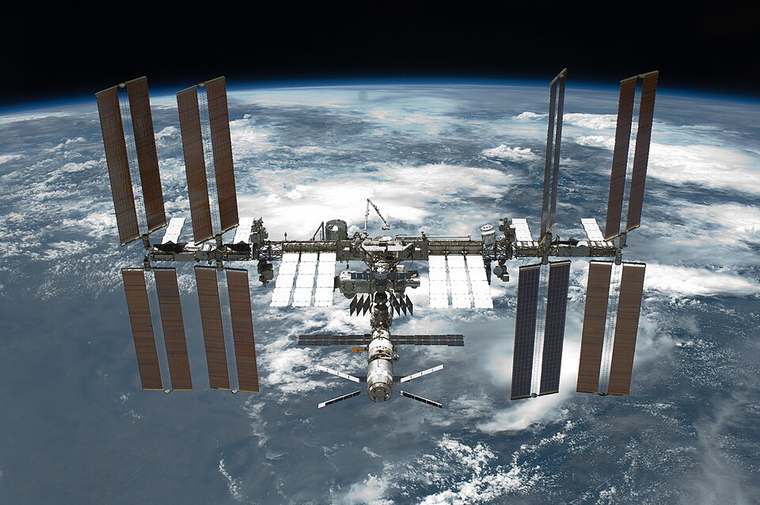
The International Space Station orbits Earth every 90 minutes
Travelling at 28,000 kilometres per hour astronauts see sixteen sunsets every day
Orbiting roughly 400 kilometres above Earth's surface, the International Space Station travels at a speed of about 27,600 kilometres per hour. At this high velocity, the station completes a full revolution around Earth every 90 minutes, allowing crew members to witness 16 sunrises and sunsets every 24 hours.
Where this comes from
Facts that can change over time are reviewed and updated. If something here looks wrong, Mondo would rather know than be confidently incorrect.
Go further
More facts like this
The Moon is tidally locked so it always shows the same face to EarthMatching rotational and orbital periods hide the lunar far side from viewEarth orbit holds millions of artificial space debris fragmentsDefunct satellites and paint flecks orbit Earth at high orbital velocitiesLagrange points provide stable orbital parking spots in spaceGravitational forces balance orbital motion at five points around two bodiesThe Moon is slowly drifting away from EarthLuni-solar tidal friction pushes the Moon outward by roughly four centimetres each yearHalley Comet returns to the inner solar system every 76 yearsThe famous periodic comet will next become visible from Earth in 2061Arthur C. Clarke conceptualized geostationary communications satellites in 1945Orbiting 35,786 kilometres above the equator allows satellites to match Earth's rotational speed
Tags: iss, orbit, space station
The International Space Station orbits Earth every 90 minutes: the short answers
- Where does this come from, and can I check it?
- Travelling at 28,000 kilometres per hour astronauts see sixteen sunsets every day. The figure is taken from NASA Science, which is linked in full on this page. Every fact on Mondo Knows names its source rather than repeating an unsourced claim.
- Is this really a space fact?
- Yes. It sits on the Space shelf, one of 1,090 sourced facts grouped into space, animals, the human body, history, science and more. Category pages collect every fact in the same field.
- What else can I read about it?
- The links under the fact point to a quiz, game, puzzle or calculator on the same subject, and the shelf below shows related facts. The wording here is original, and quoted phrases are marked as quotations.