Mondo Knows Facts
The Treaty of Tordesillas divided non-European exploration zones
Spain and Portugal drew a meridian line to claim overseas territories in 1494
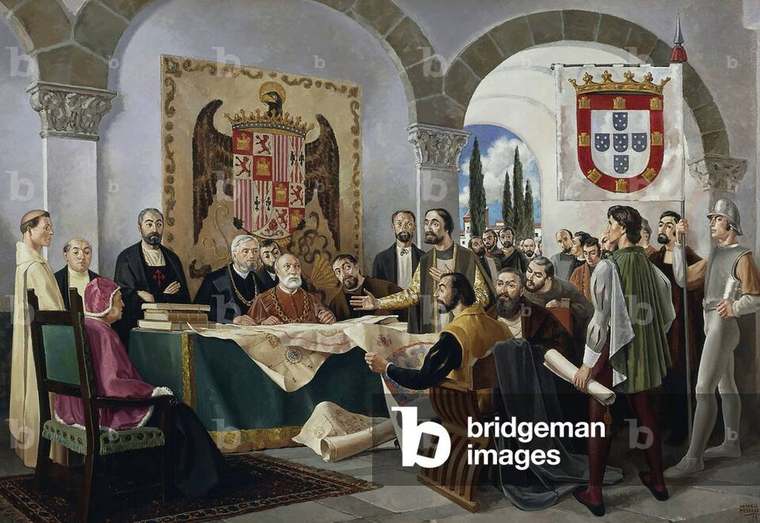
Brokered by Pope Alexander VI and signed in 1494, the Treaty of Tordesillas established an imaginary meridian line 370 leagues west of the Cape Verde Islands. Land discovered west of the line belonged to Spain, while territories to the east fell to Portugal, explaining why Brazil became Portuguese-speaking.
Where this comes from
Facts that can change over time are reviewed and updated. If something here looks wrong, Mondo would rather know than be confidently incorrect.
Go further
More facts like this
The Strait of Gibraltar separates Europe and Africa by fourteen kmConnecting the Atlantic Ocean to the Mediterranean Sea, the strait narrows to fourteen kilometres.Teaching began at Oxford University before the twelfth centuryOxford grew into the oldest university in the English-speaking world by 1096English longbowmen secured victory at the Battle of AgincourtHenry V defeated a much larger French army in muddy terrain in 1415Charles Martel checked the Umayyad advance at the Battle of ToursFrankish forces halted Islamic expansion into Western Europe in 732 CEAngkor Wat was constructed as a Hindu temple by Suryavarman IIThe Khmer Empire built the world's largest religious monument in the 12th centuryMachu Picchu was constructed high in the Andes for PachacutiInca stonemasons built dry-stone mortarless structures around 1450
Tags: treaty of tordesillas, spain, portugal
The Treaty of Tordesillas divided non-European exploration zones: the short answers
- Where does this come from, and can I check it?
- Spain and Portugal drew a meridian line to claim overseas territories in 1494. The figure is taken from The National Archives, which is linked in full on this page. Every fact on Mondo Knows names its source rather than repeating an unsourced claim.
- Is this really a history fact?
- Yes. It sits on the History shelf, one of 1,090 sourced facts grouped into space, animals, the human body, history, science and more. Category pages collect every fact in the same field.
- What else can I read about it?
- The links under the fact point to a quiz, game, puzzle or calculator on the same subject, and the shelf below shows related facts. The wording here is original, and quoted phrases are marked as quotations.