Mondo Knows Facts
Quantum dots emit vivid colours determined purely by physical size
Nanometer sized semiconductor particles tune emission light wavelengths by particle radius
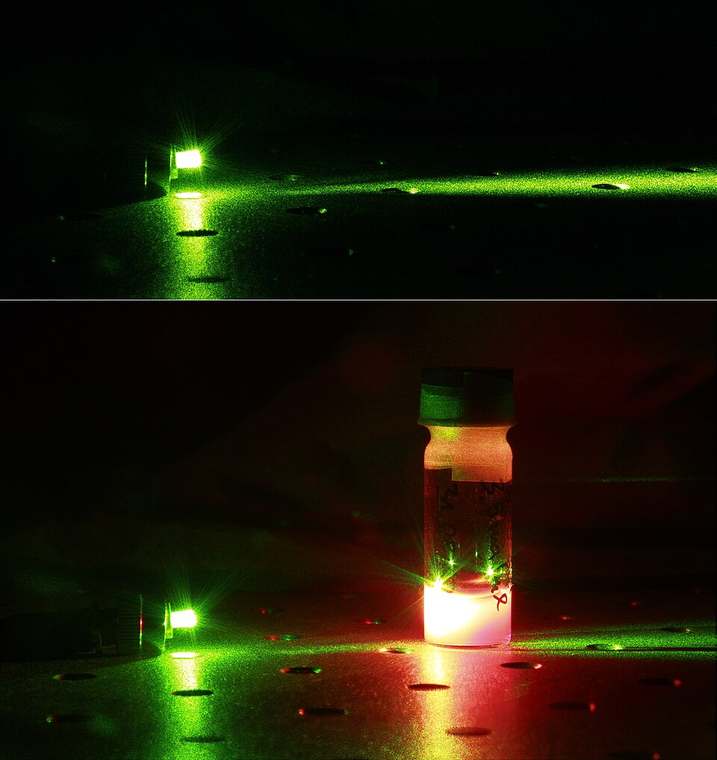
Quantum dots are semiconductor nanocrystals measuring just a few nanometres across. Because their physical dimensions are smaller than the quantum excitonic radius, electron energy levels become quantized due to spatial confinement. Larger quantum dots emit longer red wavelengths when excited by light, while smaller dots emit shorter blue wavelengths.
Where this comes from
Facts that can change over time are reviewed and updated. If something here looks wrong, Mondo would rather know than be confidently incorrect.
Go further
More facts like this
Extreme ultraviolet lithography uses 13.5 nanometre light to print microchipsEUV machines reflect invisible ultraviolet beams using precision mirrors in vacuum chambersGraphene conducts thermal energy faster than diamondStrong carbon covalent bonds transmit acoustic heat phonons with minimal scatteringAerogel is a solid synthetic material that is mostly airReplacing liquid in a gel with gas creates ultra-light solids up to 99 percent airGraphene is a single atom layer of extraordinary strengthCarbon atoms bonded in a two-dimensional honeycomb sheet are two hundred times stronger than steelPiezoelectric materials convert mechanical pressure to electricitySqueezing certain quartz crystals generates electrical voltage across their surfacesShape memory alloys return to original shapes when heatedNitinol metal remembers its manufactured form after severe physical deformation
Tags: materials, quantum dots, nanotechnology
Quantum dots emit vivid colours determined purely by physical size: the short answers
- Where does this come from, and can I check it?
- Nanometer sized semiconductor particles tune emission light wavelengths by particle radius. The figure is taken from Nobel Prize, which is linked in full on this page. Every fact on Mondo Knows names its source rather than repeating an unsourced claim.
- Is this really a science fact?
- Yes. It sits on the Science shelf, one of 1,090 sourced facts grouped into space, animals, the human body, history, science and more. Category pages collect every fact in the same field.
- What else can I read about it?
- The links under the fact point to a quiz, game, puzzle or calculator on the same subject, and the shelf below shows related facts. The wording here is original, and quoted phrases are marked as quotations.